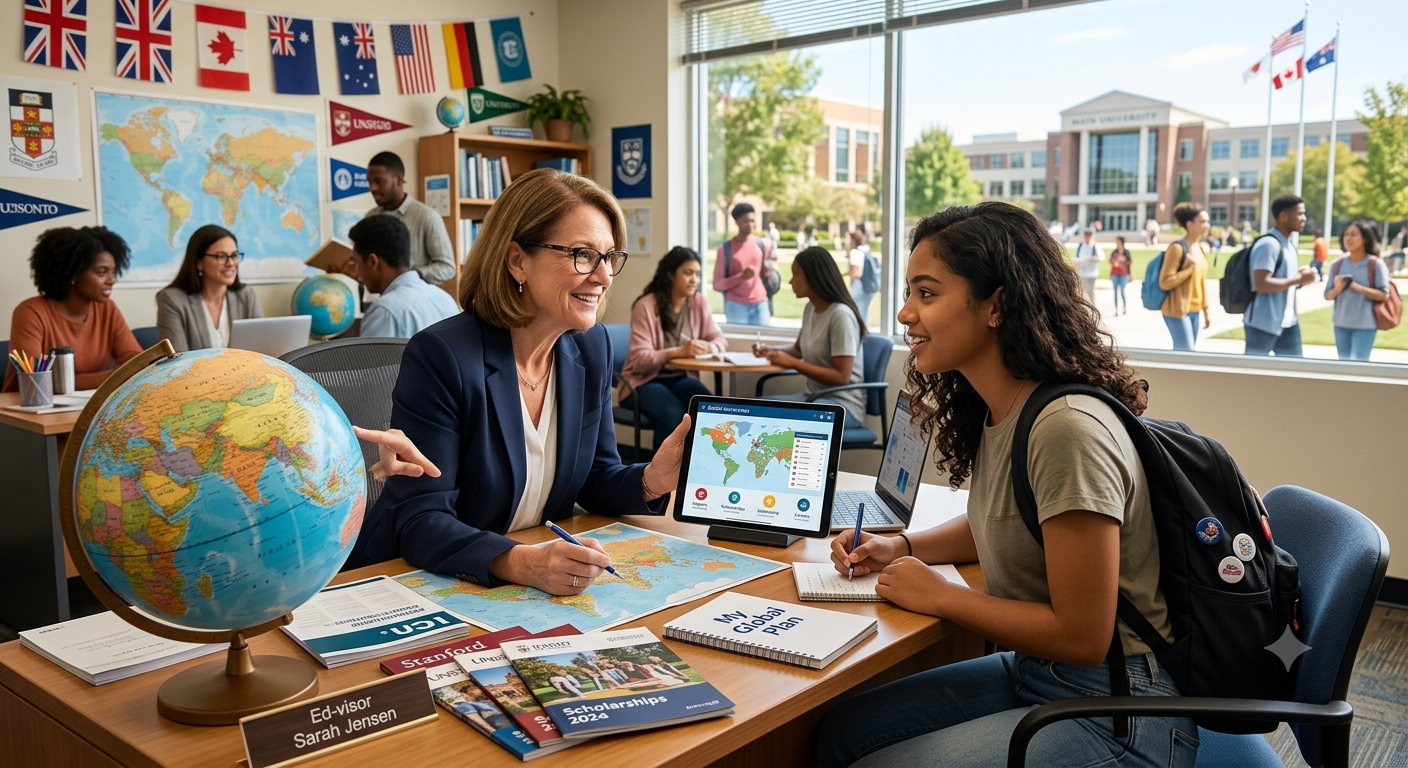
The Future of Global Education: Seven Shifts Every Student, Professional and Institution Should Prepare For: future of global education is no longer defined by the country you choose. It is defined by the mindset you develop and the opportunities you create along the way.
Beyond the Destination
Over the years, one question has remained remarkably consistent in almost every conversation I’ve had with students and parents.
Best Countries to Study Abroad in 2027: Which country should I study in?
Sometimes it’s the USA or the UK.
Sometimes Canada or Australia.
Increasingly, it’s Germany, Ireland, or other emerging study destinations.
The destinations have changed over time.
But what has changed even more is the thinking behind that question.
One of the biggest shifts I’ve observed is that students today are becoming far more strategic in the way they approach international education. Earlier, conversations often revolved around getting admission to a reputed overseas university. Today, students and their families evaluate a much broader picture. They compare career prospects, post-study work opportunities, university reputation, industry exposure, immigration pathways and long-term return on investment before making a decision.
I believe that is a healthy shift.
Because the most important decision is no longer simply where you study.
It is how that experience prepares you for the future you want to build.
That is why I believe global learning is gradually replacing the traditional idea of international education.
International Education Is Being Redefined
For decades, the study abroad journey followed a familiar path.
Choose a country.
Apply to a university.
Earn a degree.
Build a career overseas—or return home with an internationally recognised qualification.
For many students, that journey still creates exceptional opportunities.
A degree from leading universities in the USA, UK, Canada, Australia or Europe continues to carry significant academic and professional value.
However, one of the most noticeable changes I’ve seen over the years is that students are asking very different questions from those they asked a decade ago.
Earlier, the discussion centred on university rankings and admissions.
Today, students increasingly ask about internships.
Industry exposure.
Research opportunities.
Global networking.
Entrepreneurship.
Career mobility.
And future employability.
The degree remains important.
But students are rightly looking beyond the qualification itself.
They are looking for experiences that prepare them for life after graduation.
The World Has Become One Large Learning Ecosystem
Technology has fundamentally changed the way education is experienced.
A student in India can attend lectures delivered by professors in the United Kingdom.
Collaborate with classmates in Singapore.
Work on a live project with a company based in Germany.
Complete an internship with an organisation in the United States.
Or earn globally recognised certifications from institutions around the world.
Sometimes without leaving home.
Learning is no longer confined to one campus.
Nor is it confined to one country.
The classroom has expanded to include the world itself.
Universities are collaborating across borders like never before.
Students are participating in exchange programmes, virtual classrooms, international competitions and cross-border research initiatives that were difficult to imagine only a few years ago.
Global learning is no longer an exception.
It is steadily becoming the new normal.
Global Careers Are Changing Student Aspirations
Another shift I’ve found particularly interesting is how students now think about their careers.
Earlier, many viewed studying abroad as the destination.
Today, they increasingly see it as the starting point of a much larger journey.
Whether students eventually settle overseas or return home, they understand that they are entering a global employment market.
Organisations recruit talent across continents.
Remote teams work across multiple time zones.
Businesses increasingly value professionals who can collaborate across cultures and adapt to different environments.
That is why international education is becoming much more than an academic investment.
It is becoming preparation for a global career.
The universities that recognise this shift are investing heavily in internships, entrepreneurship, research collaborations, Student Mobility Is Changing: How Indian Universities Can Prepare for the Next Decade: international mobility and industry partnerships because these experiences often become just as valuable as the qualification itself.
Success Will Depend on Global Competence
During conversations with university leaders, employers and education professionals over the years, one message has remained remarkably consistent.
Academic knowledge may open the first door.
But adaptability, communication and cultural awareness often determine how far graduates progress once that door opens.
Employers today are looking beyond Degrees Are No Longer Enough: academic credentials.
They value graduates who can solve problems.
Communicate effectively.
Collaborate with international teams.
Understand different perspectives.
And adapt to rapidly changing environments.
These qualities are not developed simply by travelling abroad.
They are developed through meaningful exposure to different people, different cultures and different ways of thinking.
That, in my view, is what international education should ultimately deliver.
Not merely a foreign degree.
But a genuinely global mindset.
Choosing a University Is No Longer Enough
Every year, students spend countless hours comparing university rankings, tuition fees, scholarships and admission requirements.
Those are important considerations.
But I have often found that students spend far less time asking another equally important question.
“What kind of learning environment will help me grow?”
If there is one misconception I’ve seen repeatedly, it is the belief that a university’s ranking alone determines future success.
Rankings certainly matter.
But they rarely tell the complete story.
The opportunities available beyond the classroom often have an even greater influence on long-term outcomes.
Will the university provide internships with global organisations?
Strong industry partnerships?
Research opportunities?
Entrepreneurship support?
International exchange programmes?
Career services?
An active alumni network?
Choosing the right university remains important.
Choosing the right ecosystem is becoming even more important.
International Education Is Becoming More Inclusive
One of the most encouraging developments in recent years is that international education is no longer limited to students who can pursue a traditional overseas degree.
New pathways are making global learning far more accessible.
Hybrid programmes.
Dual degrees.
Virtual international collaborations.
Short-term exchange opportunities.
Online global classrooms.
International research projects.
Virtual internships.
These innovations allow students to build international exposure in multiple ways.
The future of education will not be defined by one pathway.
It will be defined by the willingness to keep learning across borders, disciplines and cultures.
Looking Beyond Borders
Perhaps the biggest shift is not educational at all.
It is philosophical.
The purpose of international education is no longer simply to study in another country.
It is to learn from the world.
If there is one lesson international education has reinforced for me over the years, it is this:
No single country.
No single university.
And no single degree can guarantee success.
What makes the real difference is how students use the opportunities available to them.
The graduates who will thrive over the next decade will not necessarily be those who travel the furthest.
They will be those who remain curious.
Adapt continuously.
Build relationships across cultures.
And continue learning long after they leave the classroom.
Because in an interconnected world, education should not prepare students for one country.
It should prepare them for the world.
Frequently Asked Questions
What is global learning?
Global learning is an approach that develops knowledge, skills and perspectives through international, intercultural and cross-border learning experiences. It can include study abroad, virtual collaboration, international projects, research, internships and globally connected classrooms.
How is global learning different from traditional study abroad?
Traditional study abroad usually involves travelling to another country for a degree or exchange programme. Global learning is broader and can include physical mobility as well as virtual classrooms, international projects, hybrid programmes and other cross-border learning experiences.
What should students consider when choosing a university abroad?
Alongside rankings and tuition fees, students should consider career opportunities, industry exposure, internships, research, international mobility, alumni networks, student support and the overall learning ecosystem.
Why is international exposure important for future careers?
International exposure can help learners develop adaptability, cross-cultural communication, global awareness and the ability to collaborate with people from different backgrounds—capabilities increasingly valued in global workplaces.
Key Takeaway
International education is no longer defined by crossing borders. Its true value lies in developing a global mindset, building meaningful international experiences and preparing learners to succeed in an increasingly interconnected world. The future belongs not simply to those who study abroad, but to those who learn globally.